We use cookies and similar technologies to help personalise content, tailor and measure ads, and provide a better experience. By clicking OK or turning an option on in Cookie Preferences, you agree to this, as outlined in our cookie Policy.
Cookies are small text that can be used by websites to make the user experience more efficient. The law states that we may store cookies on your device if they are strictly necessaryfor the operation of this site. For all other types of cookies, we need your permission. This site uses various types of cookies. Some cookies are placed by third party services that appear on our pages.
Thank you! Your submission has been received!
Oops! Something went wrong while submitting the form.
SRA reshapes compliance arrangements for COLPs and COFAs
September 3, 2026
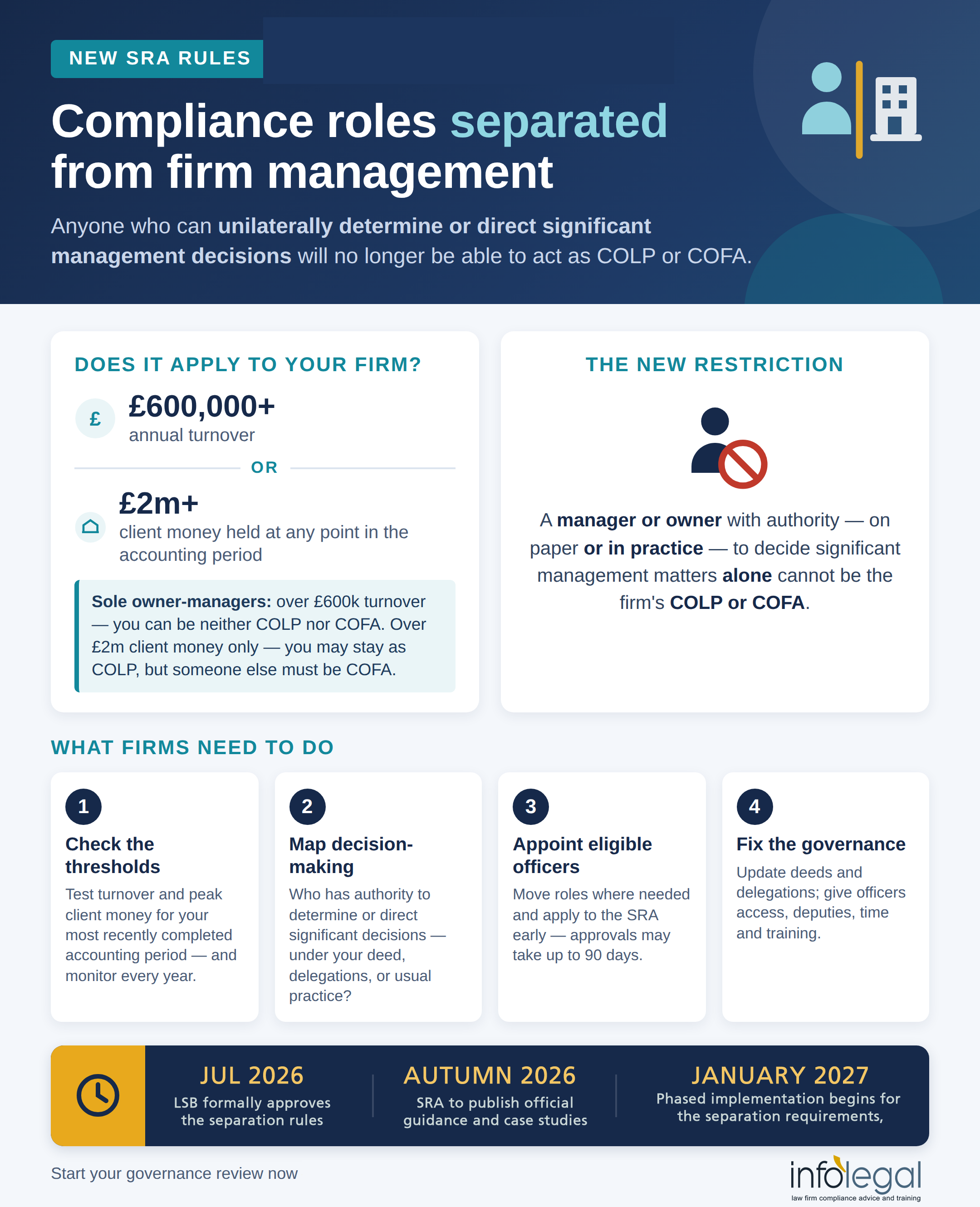
On 31 July 2026 the Legal Services Board approved changes to the SRA Authorisation of Firms Rules which will reshape compliance arrangements in most law firms of any size. From early 2027, in firms above certain financial thresholds, a manager or owner who has authority to determine or direct significant management decisions will no longer be able to act as the firm’s Compliance Officer for Legal Practice (COLP) or Compliance Officer for Finance and Administration (COFA). Sole owner-managers whose turnover exceeds the threshold will be unable to hold either role. And from April 2027 every firm holding client money will have to submit its accountant’s report to the SRA whether qualified or not — with fixed penalties for those that do not.
These are not just regulatory details that firms can ignore if they are too busy. They are possibly the most significant changes to the compliance officer regime since it was first created and could have a real and profound effect on many firms. They were approved in the teeth of opposition from the Law Society, the Sole Practitioners Group and a large part of the profession, and the SRA itself estimates (possibly somewhat conservatively) that around 1,660 firms plus 431 sole owner-manager firms will have to act if they are to continue to operate.
To assist firms, Infolegal has not only produced a comprehensive guidance note exploring what these changes mean for firms and how they are to comply with them, but also has a range of resources and checklists designed to help COLPs and COFAs to cope with and adapt to their roles which, for many, will be new and taxing roles.
The following is a short summary of some of the points covered in the guidance note.
Where the rules came from
The changes are the SRA’s response to the collapse of Axiom Ince in 2023, with a client money shortfall in excess of £60m, and to the failures of SSB Law and PM Law that followed. In each case ownership, management control and compliance oversight were concentrated in very few hands.
The SRA’s thematic review of compliance officers, published in December 2025, found that three-quarters of COLPs and COFAs were owners of their firms and that they spent about a quarter of their time on compliance.
The SRA read that as proof that the roles need separating from control. Its critics read it as proof that the problems are time, knowledge and support, none of which is solved by changing who holds the title — and many regard the reforms as an ill-thought through knee-jerk reaction to criticism of the SRA’s own supervisory failings. Both views are set out fairly in the guidance note. Whichever is right, the rules are now approved and barring an unprecedented U-turn by the SRA, firms are going to have to take steps to ensure that they are able to comply with them..
What the rules say
The new provisions are to be found in section 8 of the SRA Authorisation of Firms Rules. A new rule 8.4 applies to firms with more than one manager or owner. An individual cannot be designated COLP or COFA where, in the most recently completed accounting period, the firm had turnover above £600,000 or held client money with a maximum balance above £2m — and the individual is “a manager or owner of the authorised body who has authority whether under the authorised body’s constitution, governance arrangements or usual practice, to determine or direct significant management decisions relating to the structure or running of the authorised body”. The thresholds are alternatives, and the client money figure is the peak, not the average. Rule 8.7 provides a limited concession where the £2m line is crossed by an unrepresentative transaction, but only on prompt written notification to the SRA.
Sole owner-managers — a point of real confusion
The legal press has described the treatment of sole owner-managers inconsistently. The rule text is harsher than most summaries suggest. Under rule 8.5, a sole owner-manager whose turnover exceeded £600,000 cannot be COLP or COFA at all. Under rule 8.6, where only the £2m client money threshold was exceeded, the principal may remain COLP but must appoint an employee as COFA.
A sole practitioner with turnover above £600,000 therefore needs an employed lawyer to be COLP and an employee to be COFA — the same person may hold both if eligible. For a principal with no employed solicitor, that means recruitment, a carefully structured engagement, restructuring or a waiver application. This is the most acute case the new rules create.
What rule 8.4(b) actually means
Everything turns on these words. The bar attaches only to managers and owners — an employee, however senior, is never caught, which is why employed finance directors, heads of risk and general counsel will become the standard answer in larger firms. Authority may come from the constitution, from governance arrangements such as delegations, or from “usual practice”. Accordingly the test is one of substance, and paper changes unaccompanied by real ones will not work.
“Determine or direct” are key words in 8.4 and describes the power to settle a decision, not merely to vote on it or to block it. And the decisions must be significant ones about the structure or running of the firm — strategy, mergers, borrowing, appointing and removing managers — not the day-to-day supervision of files.
The missing word
The SRA has described the rule throughout as a bar on those who can “unilaterally” determine or direct significant decisions. That word is not in the rule. In most cases it makes no difference. A partner who needs the agreement of others cannot determine anything alone. But consider a five-partner firm where no significant decision is taken without all five agreeing.
On the SRA’s description, none of them is caught. On a literal reading of rule 8.4(b), it can be argued that all five are caught, leaving the firm with no eligible partner at all. The SRA plainly did not intend that result, but it has not yet said so. This is the single most important unresolved question in the regime. Firms should assume the purposive reading, document their governance so that it demonstrably supports collective decision-making, and press for written confirmation.
Where the problems will fall
The difficulties cluster at the small end of the profession, among firms that are financially just over a threshold but organisationally tiny. A turnover of £600,000 does not make a firm large; three or four fee-earners will normally exceed it. The two-partner firm with no other senior staff can probably keep its existing arrangement if both partners must genuinely agree every significant decision — but only if the deed, the minutes and reality all say so.
Small partnerships need to look hard at managing partners with general delegations, founders whose voice is decisive, and casting votes. Companies must look through the board to dominant shareholders. Medium-sized firms will usually need to move the COLP role away from the managing partner. Large firms with compliance departments will mostly find the rules confirm what they already do.
The people problem
One of the greatest weaknesses of the rules is that they assume every in-scope firm can find somebody eligible, competent and willing. The roles carry personal regulatory accountability, and there is unlikely to be a queue of employees waiting to carry that exposure for a business they do not own, while depending on the owner for their salary.
The COLP must be a lawyer, so experienced non-solicitor compliance managers, who are often the people who actually run compliance in small firms, are excluded from that role and may be displaced by a recruit who holds the title. Officers must be paid for the risk, insurers must be told, and remuneration at the owner’s discretion undermines the independence the rule seeks.
Above all, an officer too junior to challenge the owner is no check at all and the SRA, which must approve every designation, can refuse a nominal appointee. Our guidance note sets out how to build independence around a less senior officer, and how a written scheme of delegation can keep the firm’s existing expertise in the compliance function while accountability sits with the eligible officer.
Waivers
The SRA can waive its own rules, and rules 8.4 to 8.7 are, in principle, waivable. Waivers are exceptional, however, and an application that simply repeats the arguments the SRA has just rejected will fail.
A credible application will be specific to the firm and accompanied by evidence as to why the waiver should be granted. Reasons might include a marginal, non-recurring threshold breach with a clean compliance record, documented but unsuccessful efforts to recruit, an imminent merger or a forthcoming orderly closure.
Timing
Implementation is phased from January 2027, largest firms first, with firms holding around 99 per cent of client money covered by April 2027. The SRA has not yet published its schedule by firm band but in reality the practical deadline is earlier.
The thresholds are tested on the most recently completed accounting period, so most firms’ status is already fixed. Also, bear in mind that SRA approval of a new officer, normally around 30 days, is widely expected to stretch towards 90 as many firms apply at once. Therefore, analysis should be complete this autumn, the people question resolved by the end of the year, and applications lodged as early as possible.
What firms must do
Establish whether you are in scope. Map who in the firm can determine or direct significant decisions both on paper and in practice. Test your current officers against rule 8.4(b). Resolve the people question, honestly costed. Fix the governance, not just the names. Keep the expertise through a scheme of delegation. Apply early. Equip the officers with access, information, protected time, deputies and fair terms. Prepare for the accountant’s report regime. And watch for the SRA’s guidance, which will settle the open questions.
A full guidance note, with a term-by-term analysis of rule 8.4(b), a firm-by-firm assessment, a section on waivers and an eight-stage compliance checklist, is available for Infolegal subscribers to download together with additional resources for the COLP and COFA.